
 English
 Deutsch
 日本語
 简体中文
 Français

set.a.light 3D does not paint light, it calculates it: every lamp in your set throws the light its real counterpart throws, and the picture you get is the sum of all of them. This page explains the model behind that — what a light is made of, what one step of its dimmer is worth, and where the simulation stops making promises. Read it once and the rest of the chapter needs no theory.
Applies to BASIC, STUDIO, CINEMA · Every key named in this chapter is the same on Windows and macOS.
A light is three parts
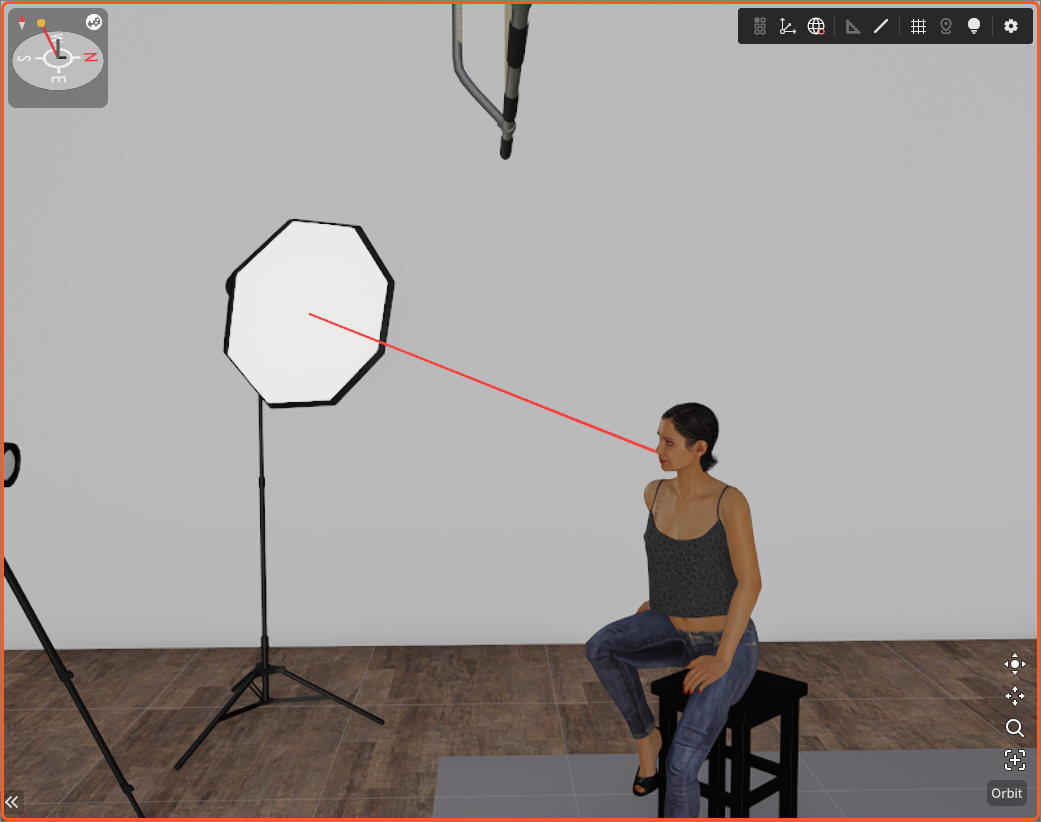
A studio light is a head (the Light Source), an optional Light Shaper in front of it, and a Rig — the stand that carries both. You pick the combination once and then shape the picture by moving, aiming and dimming it. All three parts can be exchanged later without losing the position.
A practical lamp is a different kind of object: a fixture with a lamp screwed into it. It has no shaper, no aiming and no stand of its own, which is why its inspector is much shorter — two buttons instead of six.
The catalogue is the simulation
Every head, every version of a head and every shaper variant carries its own light-distribution profile: a description of how much light that device sends in which direction. That is where the character of a light shaper comes from. A gridded softbox is genuinely narrower than the open one, not just darker, and swapping a 60 cm softbox for a 150 cm octabox changes the render the way it changes a real shoot.
It also means the catalogue entry you choose matters more than any slider. A shaper you build in your own size borrows the distribution of the template you based it on, so base a 95 cm octabox on the 90 cm entry rather than on the 150 cm one — see Add your own lights and light shapers.
Flash, continuous and practical light
Three kinds of light behave differently, and their dimmer scales say so:
- A flash fires. Its contribution to the picture does not depend on the shutter speed, only on aperture, ISO and the power you set. Studio heads are dimmed on a control range like
3.0 – 10.0, where one whole number is one stop; small flashes and speedlights use fractions like1/1 – 1/128, where each halving is one stop. - A continuous fixture burns all the time, so its contribution grows with the exposure time, just as it does on a real set. Continuous heads and practicals are dimmed in per cent.
- The modelling light of a flash head is a continuous lamp inside a flash. It follows the head’s power setting, and against the flash itself it is weak — you only see it at long exposure times or high ISO.
Whatever the scale, the units are photographic: one stop is one stop, and the light meter will confirm it — see Measure light and lighting ratios.
Light adds up
The render is the sum of every switched-on light, plus everything that bounces off walls, floor, reflectors and the model, plus the environment above and around the set. No reading separates those contributions: a head’s own light cannot be told apart from the light it bounces off the room, and a bright wall on the shadow side is part of your lighting whether you planned it or not. One head at a time can still be metered — that is what the solo switch is for, and it is how a lighting ratio is measured: Measure light and lighting ratios.
Two things are therefore worth knowing before you judge a picture. Atmosphere comes in two scales — the set-wide haze of the environment and the local plume of a fog machine, each with its own slider; see Fog and atmosphere and Add a fog machine. And a light that is switched off keeps everything else: its position, its power, its gel and its row in the set list.
One renderer, one physics
Everything is ray-traced, and the quality setting changes how finely the light is sampled, not what is simulated. A noisy picture at a low quality level is the same lighting as a clean one at a high level, measured with fewer samples, so a test at low quality is a fair preview of the final image. What is not a fair preview is the studio view: it is a working view for building the set. Judge light in the camera preview or in a finished render — see How the renderer works.
What the simulation does not promise
It is a physical model, not a calibrated instrument, and three limits are worth carrying with you. The light meter always calibrates on one fixed constant, so a comparison against your own hand-held meter can show a small offset. A scrim’s Light Reduction is a transmission figure for the fabric, not a promise of exactly that many stops at one point in the room, because the fabric also spreads the light it passes. And gel colours follow the filter maker’s published values, which a real filter on a real head can miss slightly. Within those limits the numbers transfer: an aperture the meter gives you in the program is the aperture to dial in on the shoot.